
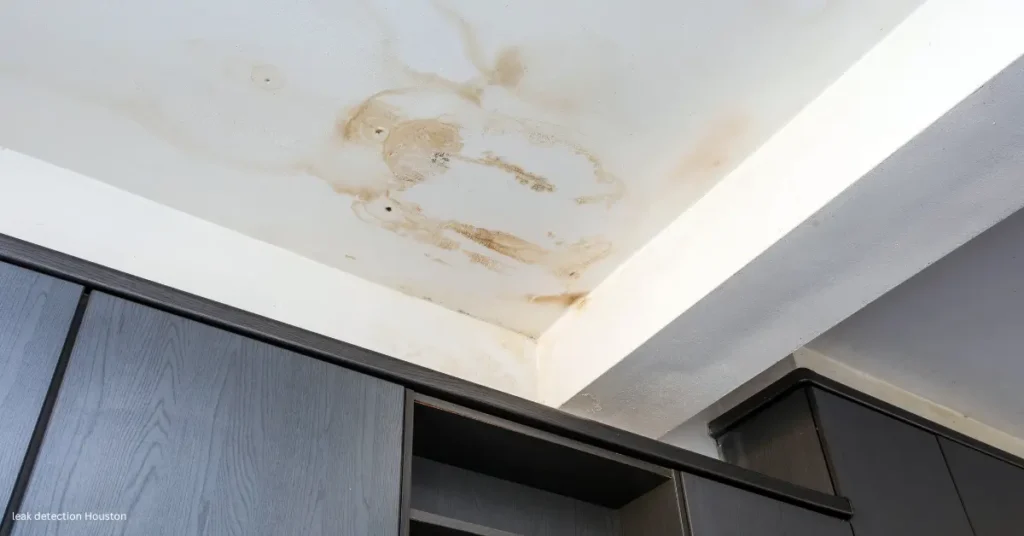
You look up while lying on the couch and there it is, a brownish ring on your ceiling that was not there last month. You check during the next rainstorm and nothing is dripping. No bucket needed, no puddle on the floor, nothing. A water stain on ceiling but no leak visible is one of the most confusing problems a homeowner can run into, because everything about it seems to contradict itself. The stain says water got in. The dry ceiling says it did not. Both of those things can be true at the same time, and understanding why is the first step to figuring out whether you have a real problem or just an old scar from something that already happened.
This guide walks through what actually causes this, how Houston’s weather makes it more common here than in most cities, and how to tell the difference between a stain you can safely ignore and one that means an active leak is still working its way through your roof.
Why a Stain Can Show Up Long After the Water Is Gone
Water carries things with it as it travels through roofing material, wood framing, insulation, and drywall. Minerals, tannins from wood, dust, and other compounds all get picked up along the way. When that water eventually dries out, those compounds stay behind, and that is what creates the yellowish or brown ring you are looking at. The water itself might have been gone for weeks. The stain is just the leftover evidence.
This is exactly why a water stain on ceiling but no leak situation trips people up. You are looking for present tense proof of a past tense event. A single hard rain, one clogged gutter overflowing at the wrong angle, or a brief plumbing drip that got fixed can all leave a mark that outlasts the actual cause by a long shot.
The Houston Factor: Why This Happens More Here
Houston’s weather pattern is almost custom built to produce this exact scenario. Long dry stretches followed by sudden, heavy downpours put a different kind of stress on a roof than steady, predictable rain does. A roof that handles light rain fine can still let water in during a sideways, wind driven storm, the kind Houston gets regularly during hurricane season and spring storm systems. Water pushed sideways under shingles or through a flashing gap does not always show up as dripping. Instead, it can travel along a rafter or piece of underlayment before soaking into drywall somewhere well away from the actual entry point.
Add in Houston’s humidity, and you get a second contributing factor even when the roof itself is fine. High humidity combined with attic temperatures that swing widely between day and night creates ideal conditions for condensation, particularly around HVAC ductwork that runs through the attic. That condensation drips slowly, over days or weeks, long before it ever becomes visible as a stain. By the time you notice the mark on your ceiling, the moisture source might already be gone, or it might still be quietly happening every afternoon when your air conditioner kicks on.
The Most Common Causes, Ranked by How Often We See Them
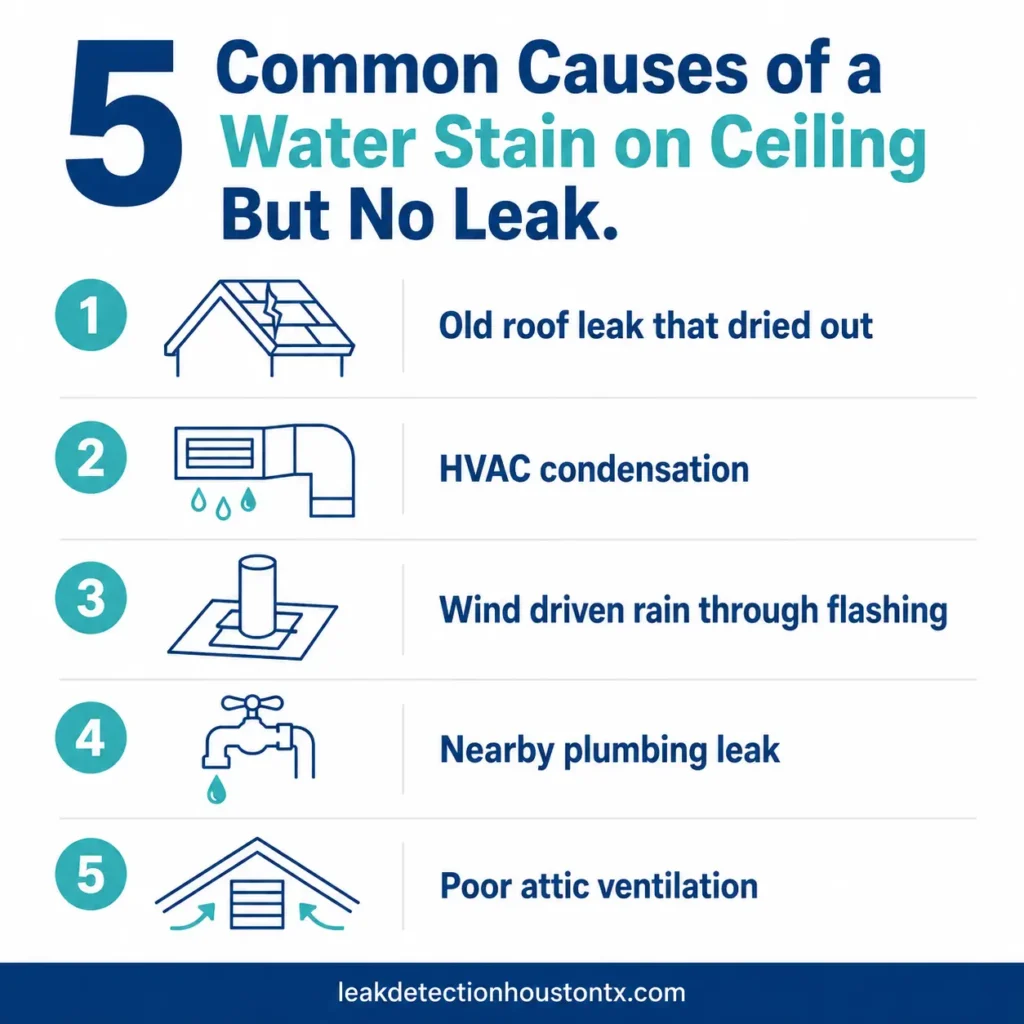
An old roof leak that has since dried out. This is the most common explanation by far. A storm caused a temporary leak, water got in, the roof has been fine since, and the stain is simply what is left behind.
HVAC condensation in the attic. Uninsulated ductwork or a cracked condensate drain pan can drip onto insulation and drywall for weeks without anyone noticing, especially in homes built before more modern duct insulation standards became common.
Wind driven rain finding a gap. Flashing around chimneys, vent pipes, and skylights is a frequent weak point. During a normal rain, water sheds off the roof fine. During a sideways storm, it can get pushed under a flashing edge that would otherwise hold up.
A slow plumbing leak nearby. If the stain sits below or near a bathroom, kitchen, or upstairs laundry area, plumbing deserves a look before you assume it is roofing at all.
Condensation from a poorly ventilated attic. Even without HVAC ducts involved, an attic with inadequate airflow can trap humid air that condenses on the underside of the roof deck itself, especially during Houston’s muggy summer months.
How to Tell If It’s Old Damage or an Active Problem
Before you call anyone, there are a few things you can check yourself that will tell you a lot.
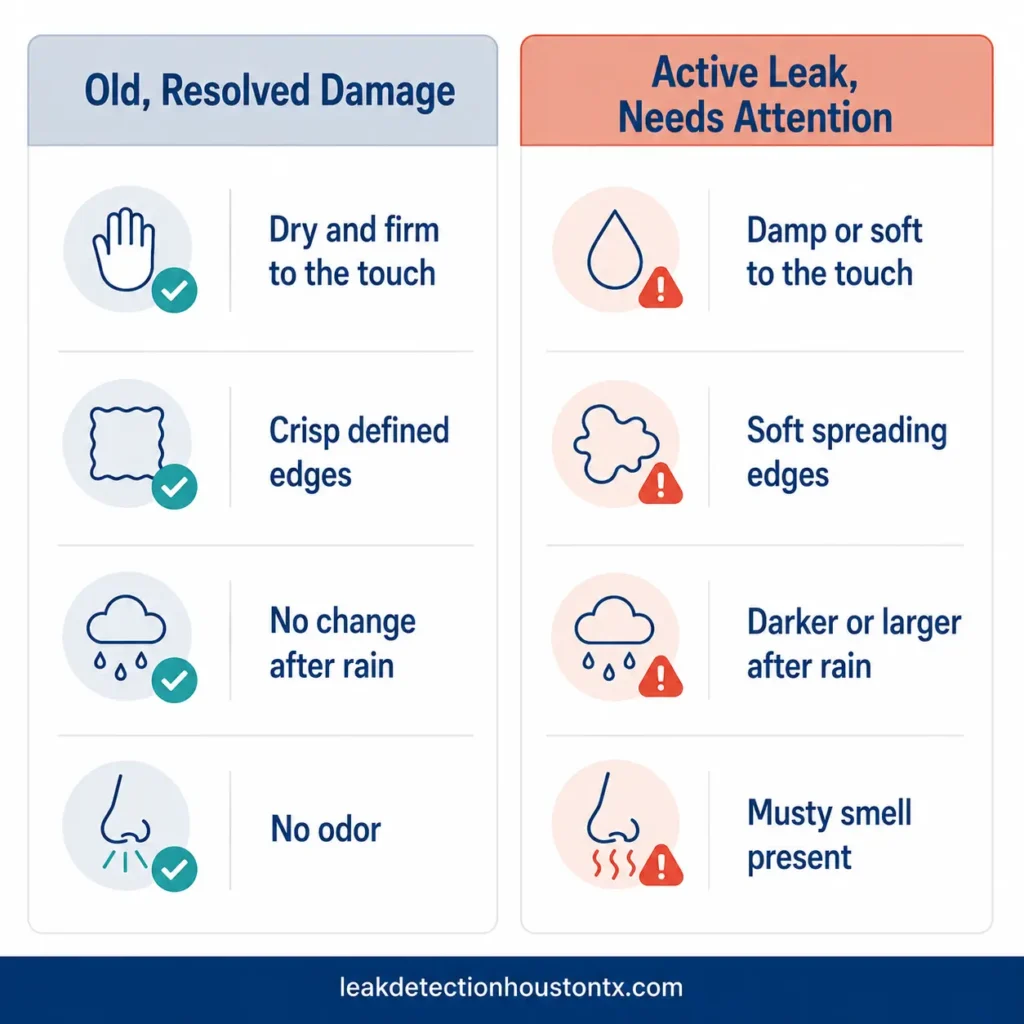
Touch the stain. If it feels damp, cool, or soft to the touch, moisture is still present and this is an active issue, not old damage. A stain that is completely dry and firm is more likely to be leftover evidence from something that already resolved.
Look at the edges. A stain with a crisp, well defined edge that has not grown suggests old, stable damage. A stain with soft, feathery, or spreading edges suggests moisture is still moving through the material.
Watch it during the next few rainstorms. If the stain gets noticeably darker or larger after a heavy rain, water is still getting in somewhere. If it stays exactly the same through several storms, that is a strong sign the original cause is gone.
Check for a musty smell. A musty odor near the stain, even without visible growth, usually means moisture has been sitting long enough for mold to start, which is a sign this needs attention regardless of whether the leak is still active.
Note the pattern. A single circular stain with a defined center often points to a point source leak, like a nail pop or a small flashing gap. A stain that follows a straight line usually points to a duct run or pipe above rather than a roof leak directly overhead.
Why “Wait and See” Is Risky, Even With a Water Stain on Ceiling But No Leak Today
It is tempting to leave a dry, stable looking stain alone, especially if painting over it seems like the easier fix. The problem is that a water stain on ceiling but no leak visible right now does not guarantee the underlying cause is actually resolved. Roof damage from a storm can sit quietly for months, only showing itself again during the next big rain event, at which point the damage is usually worse and the repair is usually bigger. Painting over a stain without confirming the source is fixed just hides the evidence. It does not fix anything underneath it.
This is especially true in Houston, where hurricane season brings repeated rounds of wind driven rain every year. A flashing gap or a cracked shingle that let water in once during one storm is very likely to do it again during the next one, and each round adds a little more hidden damage to your roof deck, insulation, and framing before it ever becomes obvious again on your ceiling.
How Professionals Confirm What’s Actually Happening
A visual check only tells you so much. Professional roof leak detection uses tools that see what your eyes cannot. Infrared thermal cameras pick up temperature differences between wet and dry materials, since water trapped under shingles or in insulation stays cooler than the surrounding dry areas, even when there is no visible sign on the surface. Moisture meters give a precise reading of how much water is actually present in the ceiling, attic decking, or insulation, which tells a technician whether they are looking at old, dried damage or something still actively wet.
The advantage of this approach is that it avoids guesswork entirely. Instead of cutting open a ceiling or tearing off shingles to look around, a thermal scan traces water back through the attic to the exact point on the roof where it is getting in, whether that is a cracked flashing seal, a gap around a vent pipe, or a section of worn underlayment. You get a marked location and a clear answer, without unnecessary damage to a roof that might not even need major repair.
What To Do Right Now If You’re Looking at a Stain
If you’re dealing with a water stain on ceiling but no leak dripping in front of you, here is a reasonable order of steps. Start with the touch test and the edge check described above, since those alone will tell you whether this looks old or active. Take a photo today so you have a clear baseline to compare against later. Watch the area through the next rain event, ideally one with wind, since that is when hidden gaps tend to show themselves. If the stain changes at all, or if you notice a musty smell, sagging, or soft drywall at any point, stop waiting and get it looked at properly.
Even if everything points to old, resolved damage, it is worth having a professional confirm that before you repaint over it. A short inspection is a lot cheaper than discovering, mid storm next season, that the original cause never actually went away.
Read About : How To Detect Roof Leaks?
How Roof Type Changes What You Should Expect
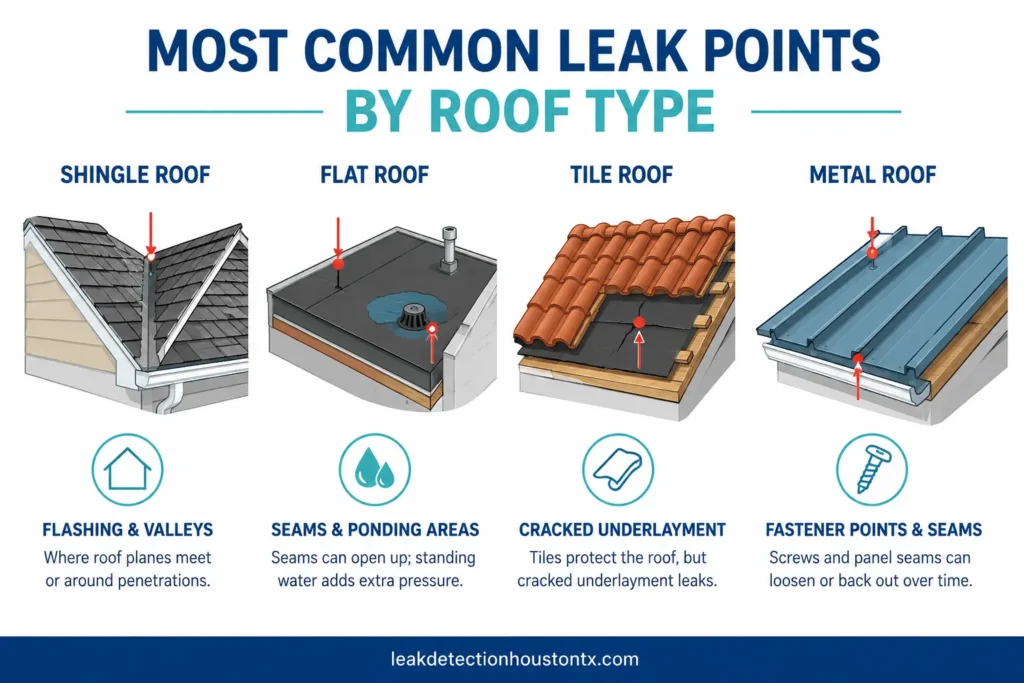
Not every roof hides a leak the same way, and knowing what kind of roof you have changes what you should be watching for.
Shingle roofs, the most common type on Houston homes, tend to leak at flashing points first: chimneys, vent pipes, and valleys where two roof slopes meet. A water stain on ceiling but no leak visible often traces back to one of these spots rather than the open field of shingles themselves, since flat shingle sections shed water well and rarely fail on their own.
Flat and low slope roofs, common on additions, garages, and commercial buildings, are more prone to ponding water and seam separation. Because there is no slope to help water run off quickly, even a small membrane failure can let water sit and slowly work its way through over days rather than showing up immediately during a storm.
Tile roofs usually leak underneath, not through, the tile itself. The tiles are mostly weatherproof, but the underlayment beneath them can crack or deteriorate with age, and a broken tile can expose that underlayment to more water than it was designed to handle.
Metal roofs most often leak at seams and fastener points rather than through the metal panels. Loose screws, worn washers, and seam sealant that has dried out over the years are the usual suspects.
Knowing your roof type will not tell you exactly where the leak is, but it does tell you where to point a flashlight first, and it helps a technician know what to check when they start an inspection.
Preventing the Next Water Stain Before It Starts
Once a stain has been checked out and either resolved or ruled harmless, a few habits go a long way toward keeping it from happening again.
Clean your gutters twice a year. Clogged gutters force water to back up under the roof edge instead of draining away, which is one of the most common and most preventable causes of edge leaks in Houston.
Have your roof looked at after major storms. Hurricane season and severe spring storms are when flashing gaps and wind lifted shingles are most likely to develop. A quick check after a bad storm catches small problems before the next rain finds them again.
Keep an eye on your attic, not just your ceiling. Ceiling stains are often the last thing to show up, well after moisture has already been sitting in the attic for a while. A quick look at your attic insulation and roof decking every few months can catch a problem earlier, while it is still small and cheap to fix.
Check your HVAC ductwork insulation. Since condensation is such a common contributor to ceiling stains in Houston’s humidity, making sure your attic ductwork is properly insulated and your condensate drain line is clear removes one of the biggest non roofing causes entirely.
Quick Answers to Common Questions
Does a water stain on ceiling but no leak mean my roof is bad? Not necessarily. It usually means water got in at some point, but the roof itself might be perfectly fine now if the original cause, like a temporary flashing gap during a storm, has already been addressed or was a one time event.
Can I just paint over the stain? You can, but only after confirming the source is actually resolved. Painting over an active issue just hides it while the underlying moisture and potential mold continue to spread out of sight.
How urgent is this really? If the stain is dry, stable, and not growing, it is not an emergency, but it is still worth a professional check, especially before your next roof related purchase decision like a sale, insurance claim, or major renovation. If it is damp, spreading, or smells musty, treat it as urgent.
Will insurance cover the repair? That depends on your policy and the cause. Storm related roof damage is often covered, while long term neglect or gradual wear typically is not. A written inspection report showing exactly what happened and when helps significantly if you do need to file a claim.
Our Roof Leak Detection Services in Houston
At Roof Leak Detection Houston TX, this exact scenario is one of the most common calls we get. Homeowners see a stain, cannot find an active drip, and are not sure whether they need a full roof inspection or nothing at all. We use infrared thermal imaging and moisture meters to answer that question directly, tracing water from the ceiling back to its exact source on the roof, without tearing off shingles or cutting into drywall to look around. This works on shingle roofs, flat roofs, tile roofs, and metal roofs, and most inspections take one to two hours.
If we find an active leak, you get a written report with the exact location marked, which you can hand to any roofer for a targeted repair instead of a guess. If the roof checks out clean, you get that peace of mind too, and you can safely repaint the stain knowing the underlying cause is actually gone. We offer same day inspections and free quotes for homeowners across Houston, Katy, Sugar Land, The Woodlands, Cypress, and Pearland, including emergency service after storms when hidden leaks are most likely to show up. If you are staring at a water stain on ceiling but no leak you can find yourself, let us trace it back to the source for you.