
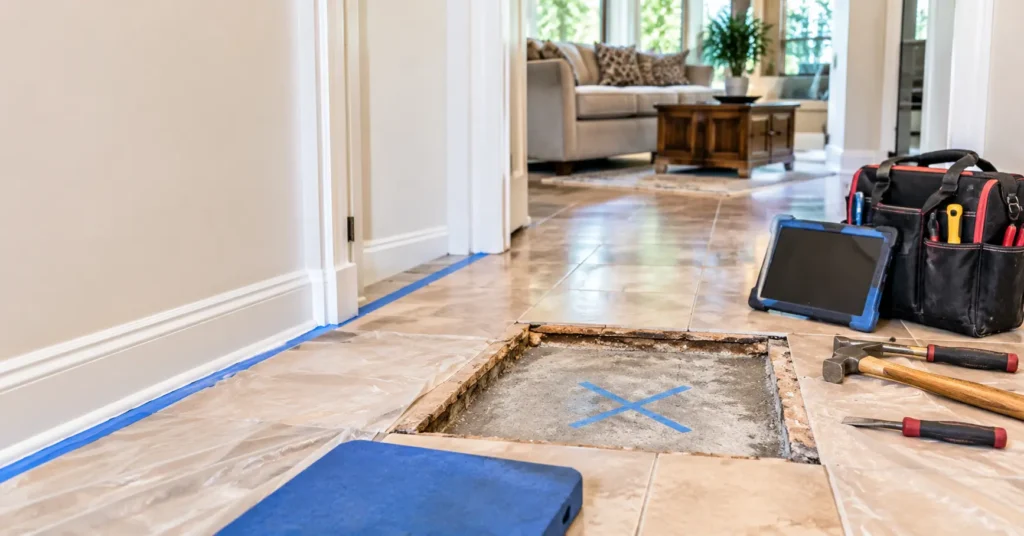
Houston home floor opened at a marked spot to show one of several slab leak repair options Opening the floor above a located leak is one of several slab leak repair options.
Finding out you have a slab leak is bad news. Finding out how many ways there are to fix it can feel even worse. One plumber says break the floor. Another says reroute the line through the attic. A third talks about tunneling under the house or repiping everything. The quotes arrive, and they can differ by thousands of dollars.
The good news is that the choices are easier to understand than they sound. This guide explains the main slab leak repair options used in Houston homes, what each one involves, where each one makes sense, and how to compare quotes fairly. If you have not confirmed a leak yet, start with our slab leak detection service, which covers the signs and how we find the leak without tearing into your floors. This article is for the next question: now that I know it is there, what are my options?
Why the Exact Location Changes Everything
Every repair method depends on where the leak is, how deep it is, what sits above it, and how many other pipes are nearby. A leak under a hallway with a bare concrete floor is a very different job than one under a kitchen with tile, cabinets, and a kitchen island.
That is why experienced plumbers and homeowners agree on one rule: locate first, repair second. A precise location lets a contractor pick the least destructive method that will still do the job. It also lets you gather several quotes that are based on the same information instead of three different guesses. Our team locates leaks only, so there is no reason for us to steer you toward a bigger repair. You get a marked spot and a written report, and then you choose which licensed houston plumber completes the work.
Why Slab Leaks Happen So Often in Houston
Houston sits on expansive clay. When heavy rain soaks it, the soil swells. When a dry spell follows, it shrinks and pulls away. Concrete slabs and the pipes under them are pushed and pulled through those cycles year after year, and joints, fittings, and thin sections of pipe are usually where trouble starts.
Pipe age and material matter too. Copper that has been in the ground for decades can corrode or develop pinholes, and hard water, high pressure, and vibration can speed that up. Some older homes also have galvanized steel or other materials that wear out sooner. Because the pipes are buried, a small leak can run for a long time. Over time, that water can wash away the soil under the slab and contribute to foundation movement and structural damage, so choosing a good repair also protects your home’s foundation.
The Main Slab Leak Repair Options
1. Spot Repair Through the Slab
This is the most direct approach. The contractor opens the floor and the concrete directly above the leak, exposes the pipe, replaces the damaged section, and then patches the slab and the flooring.
It tends to work best when there is a single, clearly located leak, the pipe is otherwise in good shape, and the area above it is easy to open and restore. It is usually the fastest option and often one of the least expensive up front. The tradeoffs are noise, dust, and the cost of restoring flooring, especially if the finish is hard to match. It also leaves the rest of the old pipe in place, so another leak elsewhere in the system is still possible.
2. Reroute the Line
Rerouting means abandoning the damaged section under the slab and running a new pipe to the same fixtures through walls or the attic instead. The old line is capped off, and the new pipe sits where it can be reached in the future.
Homeowners often like this option because it removes the problem from under the concrete for good. It avoids opening the slab in finished rooms. The tradeoffs are drywall repair and paint, sometimes visible pipe runs in closets, and a higher cost than a single spot repair. It makes the most sense when the leak is in a hard to reach area, when the same line has leaked more than once, or when the flooring above would be very expensive to replace.
3. Tunnel Under the Slab
Tunneling reaches the pipe from outside the house by digging a small tunnel beneath the foundation, without removing the floor above. It is used when the leak is under expensive finishes and rerouting is not practical.
This method protects the interior, but it is labor intensive and the price increases with the length of the tunnel. Backfill and compaction have to be done correctly so a soft spot does not form under the foundation. It also means excavation near the house, which is one reason to check for buried lines first. Our guide to the private gas line explains why a utility locate may not mark everything that runs near your home.
4. Pipe Lining or Epoxy Coating
Some contractors clean the inside of the damaged pipe and coat it with an epoxy lining that seals leaks from within. This can avoid breaking the slab in some cases.
It is not available for every situation. The condition of the pipe, the number of fittings, and the contractor’s experience all affect whether lining is a good fit, and not every plumber offers it. If you consider it, ask about the warranty, whether it is accepted for your type of line, and what happens if another leak appears elsewhere.
5. Repipe the Whole House
A repipe replaces the entire water supply system, usually with modern materials routed through the attic or walls. It is the biggest job and the highest cost, but it can make sense when the pipes are old and corroded throughout, when you have had multiple leaks, or when you are renovating anyway.
If pipes are failing everywhere, fixing one leak may simply mean waiting for the next one. A repipe addresses the cause instead of the symptom. It also takes more time and involves more disruption, so it is usually reserved for situations where a single repair would not solve the underlying problem.
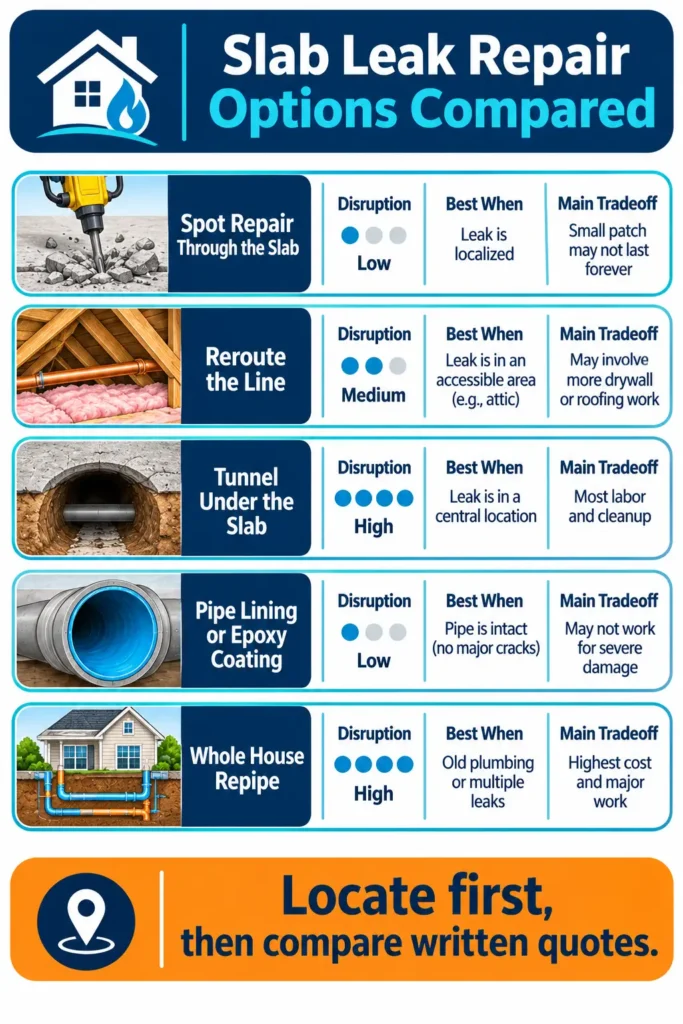
Comparing the Slab Leak Repair Options Side by Side
| Option | Disruption | Often a good fit when | Main tradeoff |
|---|---|---|---|
| Spot repair through the slab | Moderate, localized | One clear leak, easy to restore | Old pipe elsewhere stays in place |
| Reroute the line | Moderate, walls and attic | Hard to reach area or repeat leaks | Drywall and paint work, higher cost |
| Tunnel under the slab | Low inside, digging outside | Leak under costly finishes | Labor heavy, price rises with distance |
| Pipe lining or epoxy coating | Low in the right case | Pipe condition and access allow it | Not available or suitable everywhere |
| Whole house repipe | High, but one time | Old pipe, multiple leaks, renovation planned | Highest cost and longest timeline |
What Slab Leak Repair Costs
The price of slab leak repair options varies widely by home, method, and contractor, so treat any number as a rough guide. Published cost guides commonly put a simple slab leak repair from about a thousand dollars into the several thousand dollar range, with Houston specific estimates often landing in the low to mid thousands for a single repair. Rerouting, tunneling, lining, and repiping usually cost more, and a whole house repipe can reach well into five figures for larger homes.
Two points can help you compare fairly. First, ask what each quote includes. Some cover only the pipe repair, while others also include drywall, flooring, drying, and mold checks. Second, remember that a lower price now is not always the lowest total cost. A cheaper patch on a failing system can lead to another repair, while a larger repair can prevent repeated work. If the cost is a concern, ask each contractor about financing options before you decide.
What About Insurance?
Coverage depends on your policy and the details of the loss. Many policies cover resulting water damage in some situations but may not cover the cost of fixing the pipe itself, and some limit what they pay for tearing out and restoring materials to reach the leak. Some policies exclude damage from long term leaks or wear.
Before authorizing work, call your agent and ask what is covered, what documentation is required, and whether you need to get approval first. Keep your leak report, photos, quotes, and receipts. This is general information, not legal or insurance advice, so check your own policy for the details.
How to Choose and What to Ask Contractors
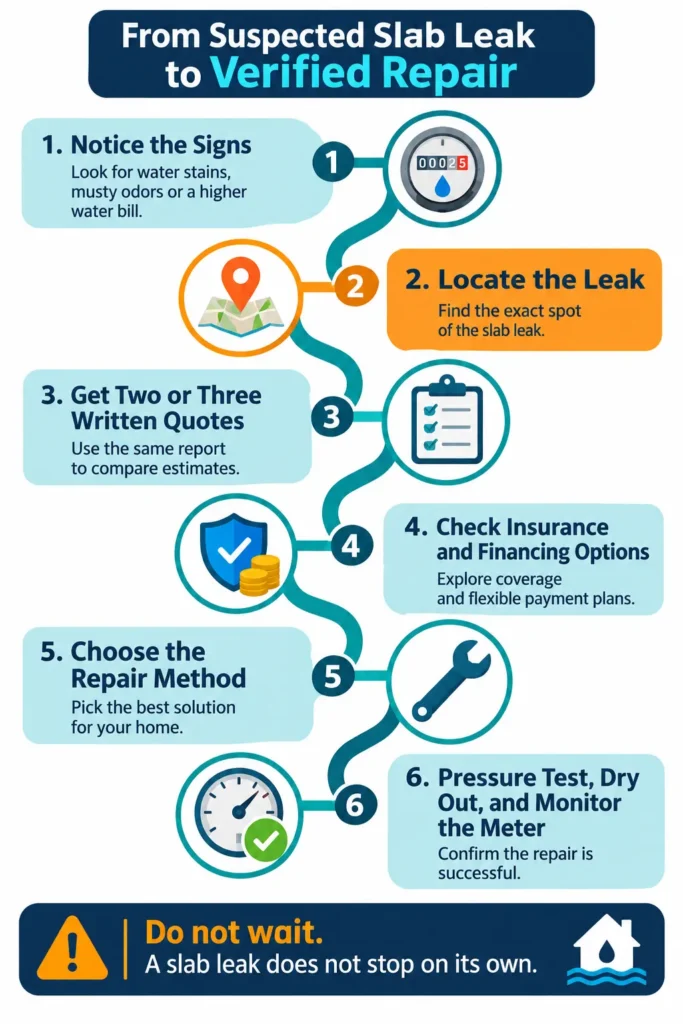
Choosing among slab leak repair options gets much easier once you have the leak location and a short list of questions to sort the quotes.
- Which slab leak repair options do you recommend for my situation, and why?
- Will you provide the quote in writing, with what is included and what is not?
- Do you expect other leaks, and how will you check the rest of the system?
- How will you restore the flooring, drywall, and paint, and who handles it?
- What warranty comes with the pipe repair and the restoration work?
- Do you handle permits if they are required?
- What financing options do you offer for a larger job?
Get at least two or three written quotes, and give each contractor the same leak report so they are bidding on the same problem.
After the Repair
A good repair is not finished until the area is dry and checked. Ask the contractor to pressure test the line and confirm the leak is stopped. Monitor your water meter for a few days to make sure it holds still when everything is off. Dry out any damp materials promptly, because mold and mildew can start in a day or two when materials stay wet. Watch for new cracks, sticking doors, or uneven floors, which may be signs the foundation was affected.
Annual plumbing inspections and attention to your water pressure can catch problems early before they turn into another slab leak.
Other Lines Can Be Involved
A slab leak is usually a pressurized water supply line, but it is not the only pipe under a Houston home. Drain and sewer lines can also crack or shift, especially in older homes. If your home is older or you have recurring drain trouble, our guide to a sewer line inspection before buying a home explains what a camera inspection can reveal. If your yard is wet or your bill jumps while the house seems dry, the leak may be outside, and our article on an underground water line leak explains who is responsible and what to do. If you ever smell gas near the house, leave, call 911 and your gas utility, and see our gas leak detection page for next steps.
Frequently Asked Questions About Slab Leak Repair Options
What is the cheapest slab leak repair option?
A spot repair through the slab is often the lowest up front cost, but the cheapest option depends on your home. If the pipe is old or there are several leaks, a larger repair may cost less over time.
Can a slab leak be fixed without breaking the concrete?
Sometimes. Rerouting, tunneling, and pipe lining can reduce or avoid breaking the slab. The right choice depends on the leak location and your plumbing.
How long does a slab leak repair take?
Many repairs take from a day to a few days. Rerouting, tunneling, and repiping can take longer, and restoration work adds time.
Do I have to move out during the repair?
Not always, but some repairs create dust, noise, and water shutoffs. Ask your contractor what to expect for your home.
Should I fix a small slab leak now or wait?
Fix it soon. A slab leak does not stop on its own, and running water can erode soil and add to foundation problems over time.
Know Where the Leak Is Before You Choose
The best slab leak repair options start with a precise location. If you suspect a leak under your floors, call us today for a free quote and same day service across Houston, Katy, Sugar Land, and The Woodlands, or visit the Leak Detection Houston home page to see everything we cover.