
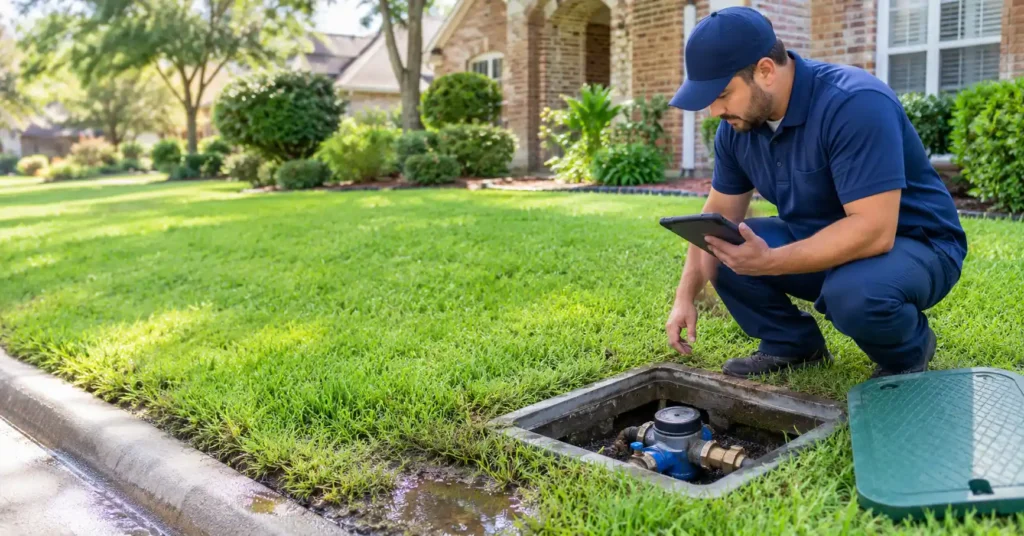
You notice a soggy patch of grass near the curb. Or your water bill jumps for no clear reason, even though nobody changed their habits. Somewhere under the lawn, an underground water line leak may be sending water into the soil day and night. Most Houston homeowners think about finding the leak first. But the question that actually slows people down is simpler: whose problem is this, mine or the city’s?
The answer decides who calls whom, who pays for the repair, and how quickly the water stops running. This guide walks through what an underground water line leak really is, where homeowner responsibility begins, what Houston soil does to buried pipes, and the exact steps to take once you suspect something is wrong. If you want the full breakdown of how we locate buried leaks, our underground leak detection services page covers the methods and equipment. This article focuses on what happens around the leak: responsibility, money, insurance, and prevention.
What Is an Underground Water Line Leak?
Your home gets water through a chain of buried parts. The water main runs under the street and belongs to the utility. A smaller pipe called the service line branches off that main and carries water toward your property, usually passing a curb stop and a water meter along the way. From the meter, the private line continues underground until it reaches the house and connects to your indoor plumbing.
An underground water line leak is any crack, joint failure, or hole in that buried path. It might be a worn fitting near the meter, a split in older galvanized pipe, a root crushing a section of plastic line, or a joint that pulled apart when the ground moved. Because the pipe is buried, the water does not always show itself right away. It can soak into the soil for weeks before anything appears on the surface.
That is what makes this problem expensive. A burst pipe inside a wall announces itself. A slow underground water line leak just keeps running, and you pay for every gallon.
Who Is Responsible for an Underground Water Line Leak in Houston?
This is where most confusion starts. The general rule across the country is that the utility handles the water main and the portion of the service line up to a dividing point, often the meter or the curb stop. Everything past that point, on the private side, is usually the property owner’s job. Houston follows the same basic idea: public pipes and pipes in the public right of way are handled by Houston Public Works, while private lines closer to the home are generally the homeowner’s responsibility.
Here is the catch. Meters are not always placed close to the house. In some neighborhoods the meter sits near the street while the home is set far back, which means a long stretch of private pipe runs through your yard and sometimes beneath a driveway or sidewalk. In rare cases homeowners have reported disputes about where the line of responsibility sits when the pipe crosses the public right of way. That is why you should never assume. Confirm the dividing point for your property before you spend money.
A quick way to think about it:
| Where the leak is | Who usually handles it |
|---|---|
| Water main under the street | Houston Public Works |
| Service line from the main to the meter | Usually the utility, but confirm for your address |
| Private line from the meter to your house | Homeowner |
| Plumbing inside the home | Homeowner |
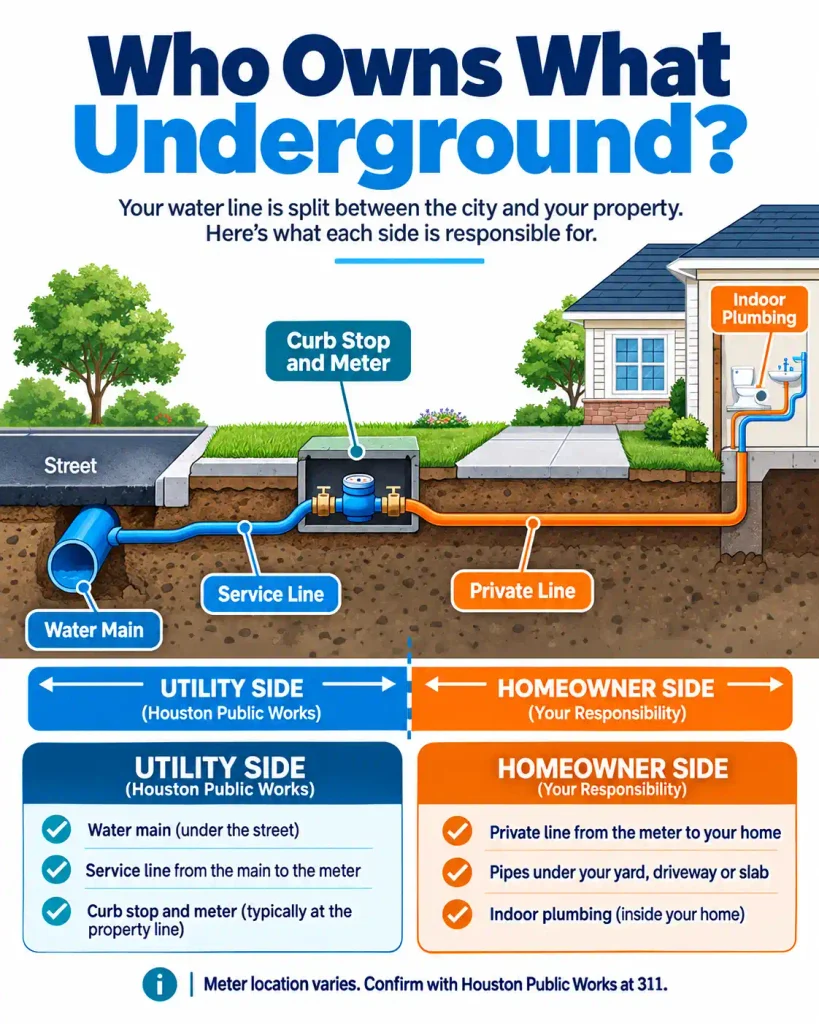
If you are not sure which side your leak is on, call 311 and ask Houston Public Works. Then get the exact location pinned down so you are having the conversation with facts, not guesses.
Why Houston Is Hard on Buried Pipes
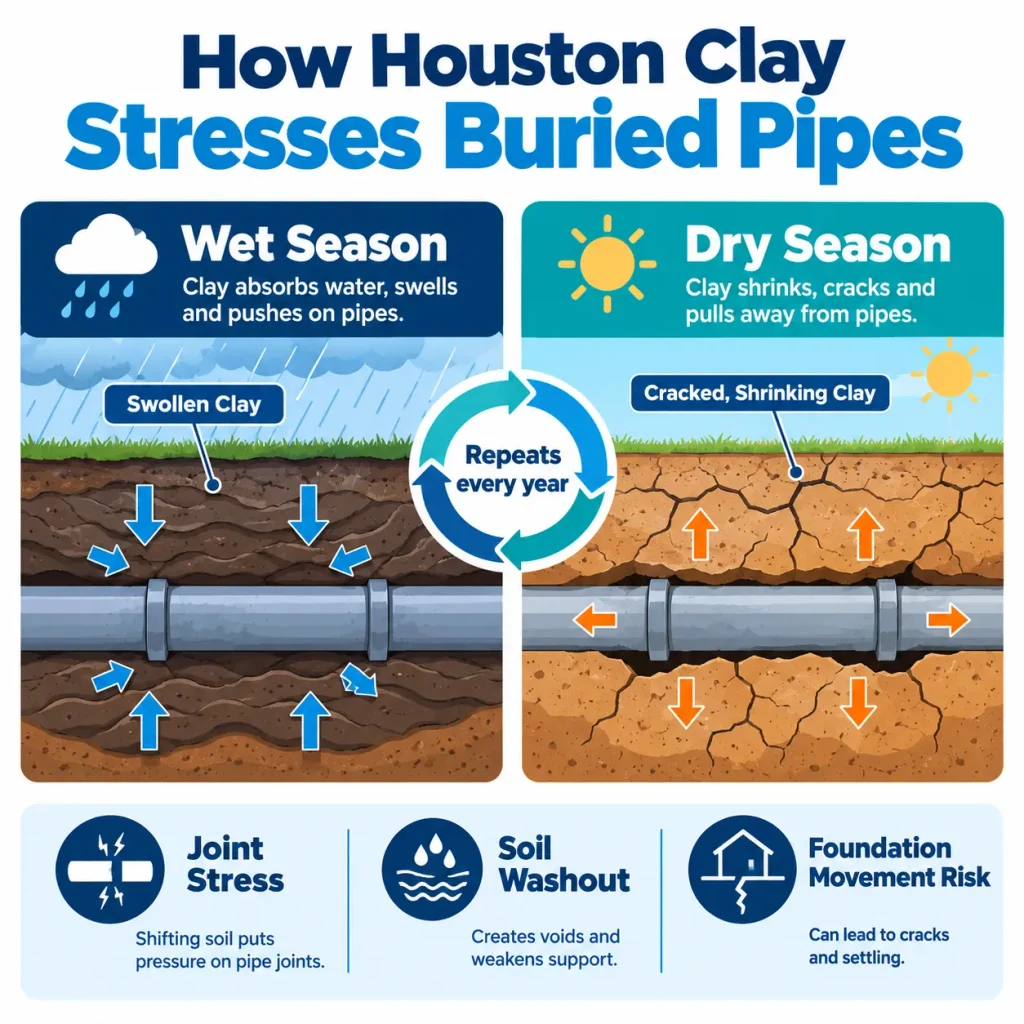
Houston has a reputation for foundation trouble, and the same forces that move concrete slabs also stress the pipes around them. Much of the area sits on expansive clay. When heavy rain soaks that clay, it swells. When a dry spell follows, it shrinks and pulls away. Pipes buried in that soil get pushed, pulled, and bent season after season, and joints are usually the first place to give.
High humidity and long wet seasons keep soil saturated, which makes it harder to spot a new leak. Drought has the opposite effect. Dry soil cracks, loses support under the pipe, and then a hard rain drives water into those gaps. Older homes add another layer of risk because their original service lines may be galvanized steel or early copper that is simply reaching the end of its life.
A few other local factors push things along:
- Tree roots seek out moisture and can wrap around or crush buried pipe.
- High water pressure, even when it seems like a good thing, strains fittings over time.
- Shifting soil near a slab can pull on pipe where it enters the house.
- Previous patch repairs sometimes become the next weak point.
A buried leak that keeps running can also wash soil away from the area around the pipe. Over time that raises the risk of foundation movement and costly structural damage, especially when the leak sits close to concrete slabs or footings.
Warning Signs That Should Not Wait
You do not need a long checklist to know something is off. Pay attention to a few signals that point toward the private side of your line.
Your bill rises with no change in how you use water. Your meter keeps moving after everything inside is off. You see damp spots or a patch of lawn that stays green and soggy when the rest is dry. Water pressure drops, sometimes only at certain faucets, which is a common red flag for a pipe problem somewhere along the main line or service line.
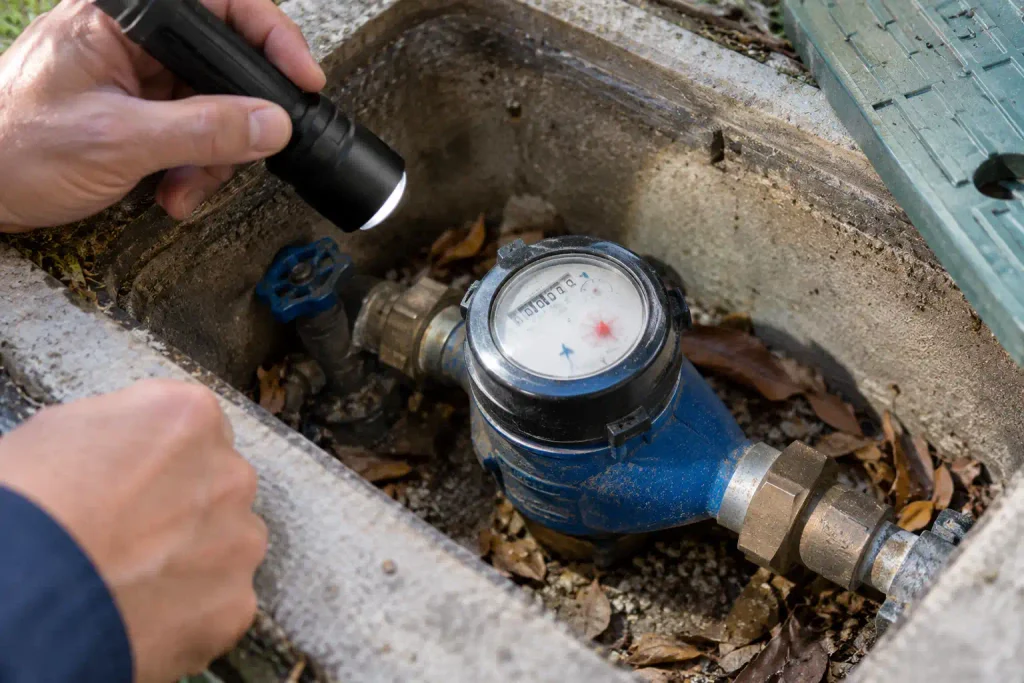
A simple home check helps. Turn off every tap and appliance, then look at your meter. Many meters have a small low flow indicator, often a tiny triangle or dial, that spins when even a slow leak is running. If it keeps moving, water is going somewhere. Take a photo with the date visible. You will want it later.
What to Do When You Suspect an Underground Water Line Leak
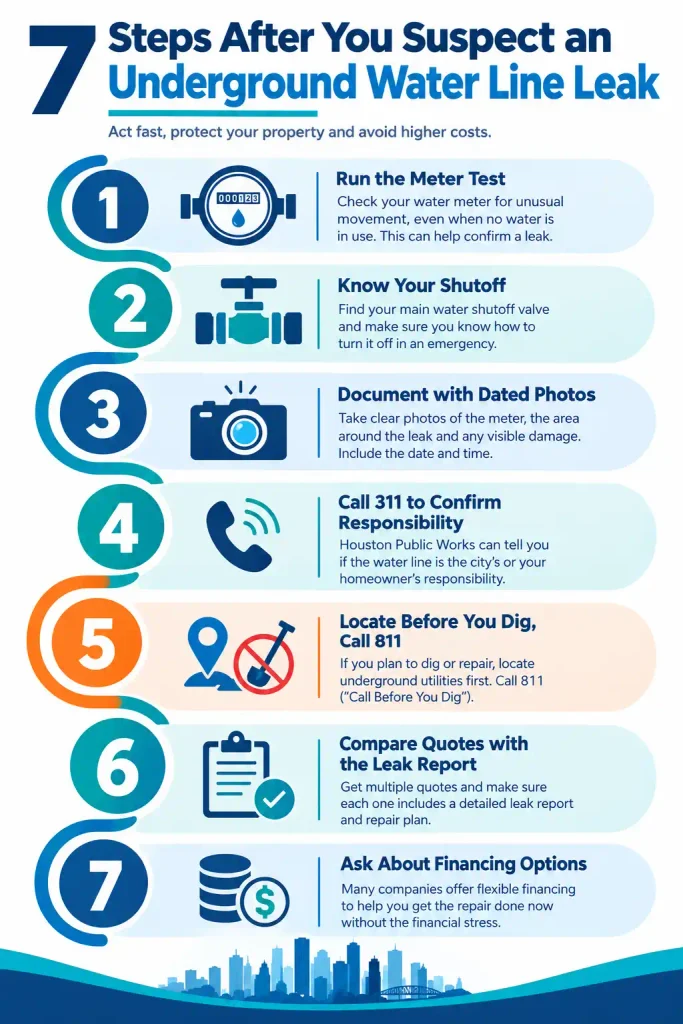
Panic is the usual first reaction, followed by a call to the nearest plumber. A better approach is to work through a short sequence. Doing things in this order protects your wallet and often your yard.
Step 1: Confirm it is real. Run the meter test described above and record the reading. If the meter moves with everything off, you have confirmation that water is escaping somewhere past the meter.
Step 2: Check the shutoff. Know where your main shutoff valve is. If water is surfacing or flooding a low spot, close it and call for help right away.
Step 3: Document everything. Take dated photos of the meter, the wet area, and your recent water bills. If you later ask for a bill adjustment or file an insurance claim, this record is your evidence.
Step 4: Find out which side of the line you are on. Call 311 if the problem looks close to the meter, the curb, or the street. Ask Houston Public Works what they handle at your address.
Step 5: Get the exact location before any digging. This step saves the most money. A pinpointed location lets a houston plumber open one small area instead of trenching across your yard. Texas law also requires calling 811 before digging so buried utility lines are marked.
Step 6: Collect repair quotes using the leak report. A written location report lets you compare quotes fairly, since every contractor is bidding on the same spot.
Step 7: Ask about financing options if the job is large. Replacing a long section of line can be a serious expense, and many contractors can explain payment plans before the work begins.
Does Homeowners Insurance Cover an Underground Water Line Leak?
It depends on the policy, and the answer is often less generous than people hope. Standard homeowners coverage frequently handles sudden and accidental water damage inside the home but may exclude damage from slow leaks, wear and tear, or the buried pipe itself. Coverage for the line between the meter and the house can be limited or missing altogether unless you added a specific endorsement.
Some insurers and third party companies sell service line protection plans meant to cover repair or replacement of buried lines. If you do not have one, ask your agent three questions: Is the exterior service line covered? Is a gradual leak excluded? What proof will you need for a claim? Your dated photos and a professional leak report answer most of those proof questions.
This is general information, not legal or insurance advice, so check your own policy language for the details that apply to you.
What Repair Actually Looks Like After the Leak Is Found
Once the location is clear, you usually face one of three paths. A spot repair replaces a small damaged section and works well when the leak is isolated and the rest of the pipe is healthy. Trenchless replacement pulls or bursts a new line through the old path with limited surface digging, which suits long runs under landscaping or hardscape. A full excavated replacement is the traditional option and sometimes the only practical one.
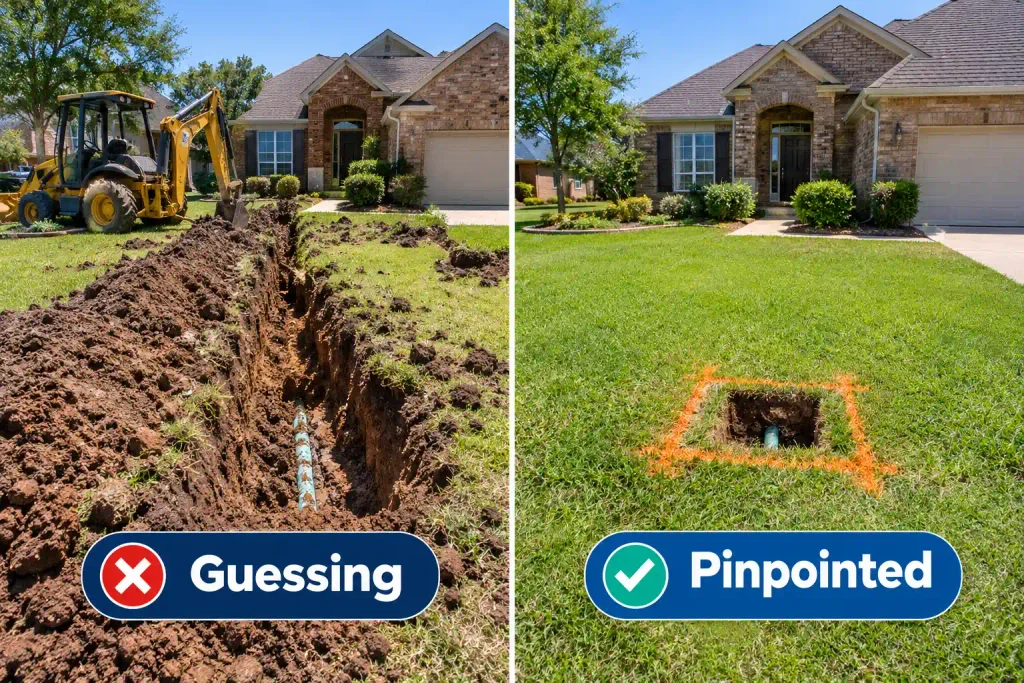
The right choice depends on pipe age, material, depth, length, and what sits on top of it. This is also where accurate locating pays for itself. Without it, contractors may dig wider to be safe, and that adds labor, restoration, and cost. With it, pipe repair or water leak repair can often be limited to one controlled opening.
Prices vary a lot by depth and surface, and a repair on a long line can reach several thousand dollars. If you want a rough idea of what the water itself is costing you while you wait, try our water leak cost and waste calculator or the leak rate calculator.
Locate First, Then Repair
Experienced homeowners and plumbers tend to agree on one rule: never dig on a hunch. Pinpointing the leak first keeps the repair small, the report neutral, and the quote honest. Our team only locates leaks. We do not repair them, so there is no reason to recommend a bigger dig than you need. You receive a marked spot and a written report, then you choose who completes the work.
If you are dealing with a wet yard, a spiking bill, or low pressure and want an exact answer, our underground leak detection in Houston team can inspect your property without tearing it up. Leaks closer to the house sometimes point toward the slab, and our slab leak detection service covers that case. For a general check inside the home, see our water leak detection page.
How to Reduce the Chance of a Future Underground Water Line Leak
You cannot control Houston soil, but you can lower your odds.
Keep soil moisture around the foundation consistent, since big swings between wet and dry are what push pipes around. Check your water pressure with an inexpensive gauge, because high pressure is quietly hard on joints and fittings. Keep large trees and aggressive roots away from known line routes. Schedule annual plumbing inspections so small issues get noticed before they turn into significant damage. Learn where your shutoff valve and meter are, and make sure everyone in the house knows too.
If you have an older home with its original service line, ask a licensed professional to evaluate its condition. Replacing a worn line on your own schedule is almost always cheaper than replacing it in an emergency.
Frequently Asked Questions About an Underground Water Line Leak
Can an underground water line leak raise my water bill without any visible signs?
Yes. Water can soak into the soil without ever reaching the surface, especially in clay or when the pipe is deep. A rising bill and a moving meter are often the first and only clues.
Does the city fix a leak on my side of the meter?
Usually not. The private side of the line is generally the homeowner’s responsibility. Call 311 to confirm where responsibility begins at your address, since meter placement varies.
Can I ask for a bill adjustment after a leak?
You can ask Houston Public Works whether you qualify. Bring your dated meter photos, bill history, and proof of the repair. Approval is not guaranteed, so do not count on it.
Should I dig first to see what is going on?
No. Exploratory digging is the most common way homeowners add cost to a repair. Locate first, then open only the spot that needs attention.
How fast should I act on an underground water line leak?
As soon as you have confirmation. Leaks do not stop on their own, and the longer water runs, the higher your bill and the greater the risk of soil erosion near your foundation.
Next Step
A small underground water line leak rarely stays small. If your meter keeps moving, your yard stays wet, or your bill makes no sense, get the location confirmed before you spend a dollar on repairs. Call us today for a same day service across Houston, Katy, Sugar Land, Cypress, Pasadena, Memorial City, Riverside ,The Woodlands and other surrounding areas.