
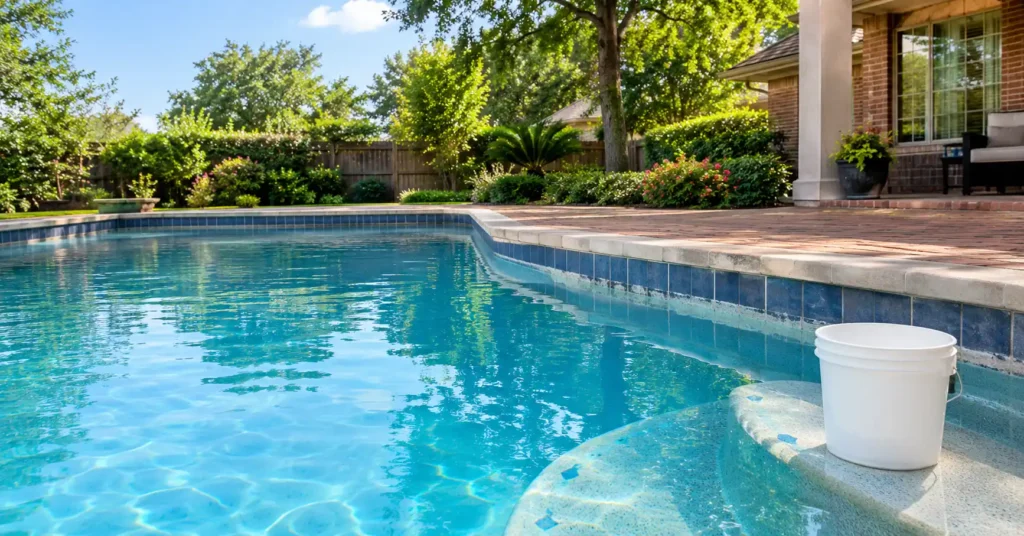
Houston backyard pool with a low waterline and a bucket on the step for a pool losing water test A pool losing water is not always a leak, but a simple bucket test can tell you.
You skim the pool on a Saturday morning and notice the waterline sits lower than it did last weekend. Maybe the autofill has been running more than usual. Maybe a dry ring has shown up on the tile and you cannot remember when it started. A pool losing water is one of the most common worries for Houston homeowners, and it is also one of the most misunderstood, because every pool loses some water every single day.
The real question is whether your pool is losing water the normal way or the expensive way. This guide shows you how to tell the difference at home, using a simple test and a few honest observations. You will learn what normal looks like in Houston heat, what the numbers mean, what can fool you, and what to do once you know. If your own checks point toward a leak and you need it found without draining the pool, our pool leak detection service handles that part. This article is about getting to a confident answer first.
Why Every Pool Loses Some Water
Evaporation is the quiet thief. Sun, heat, and wind pull water off the surface all day, and warm water gives it up faster than cool water. Splash out, backwash, and swimmers climbing out add a little more. For a typical residential pool, a quarter inch a day is a common baseline, and in hot, windy weather it can climb toward half an inch.
To put that in perspective, a quarter inch of loss on a pool with about 400 square feet of surface is roughly 60 gallons. Over a week, that adds up to a couple of inches and several hundred gallons. So a lower waterline alone does not prove a leak. What matters is whether the loss is more than the weather can explain.
Houston has its own twist. Long, hot summers push evaporation high. But high humidity slows evaporation down, so a muggy week can make normal loss look smaller than you expect. That means a pool losing water quickly during a cool, humid stretch deserves more suspicion than the same loss during a scorching, windy afternoon.
What Is Normal and What Is Not
Rough guidelines help, though they are not laws. Use them as a starting point, not a verdict.
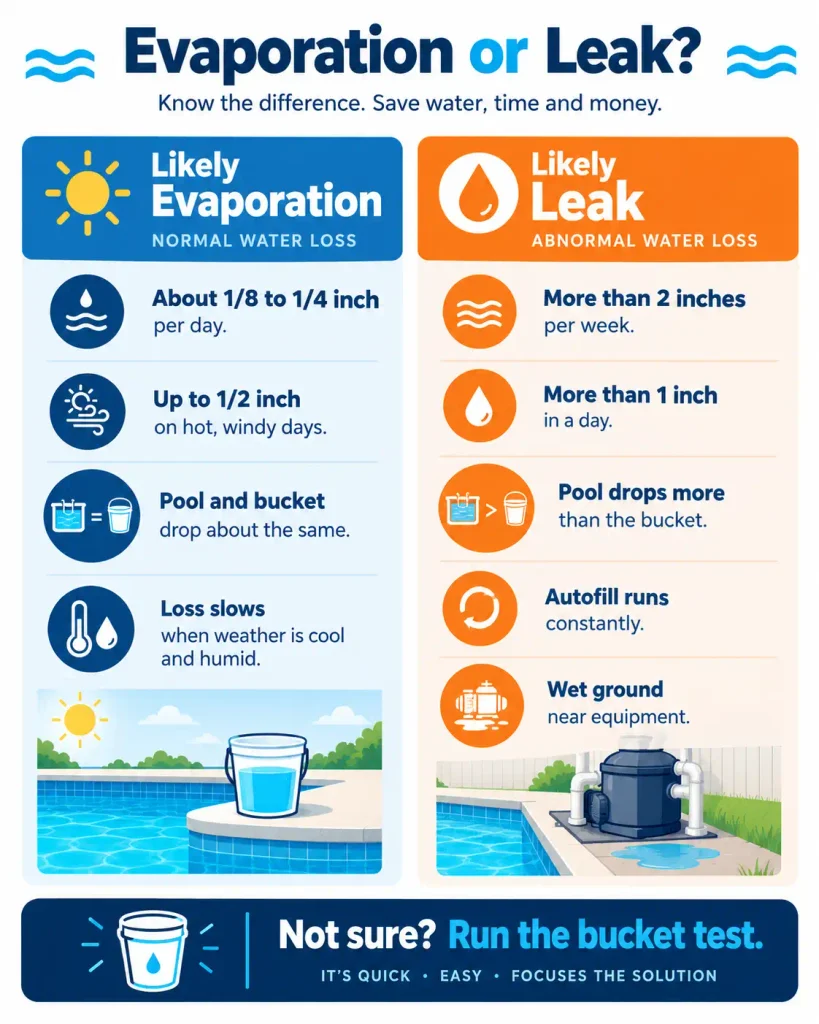
- Up to about a quarter inch per day is usually ordinary evaporation.
- Up to half an inch per day can be normal in hot, dry, or windy conditions.
- More than two inches in a week, week after week, is a reason to look closer.
- More than an inch in a single day almost always points to something other than evaporation.
Your pool’s size, shape, sun exposure, water temperature, and whether you run waterfalls, fountains, or a spa spillover will shift these numbers. Water features speed up evaporation because they throw water into the air. A pool cover slows it down dramatically. That is why the best method is not guessing from a chart. It is measuring your own pool against the same weather.
The Bucket Test: Your Best First Move
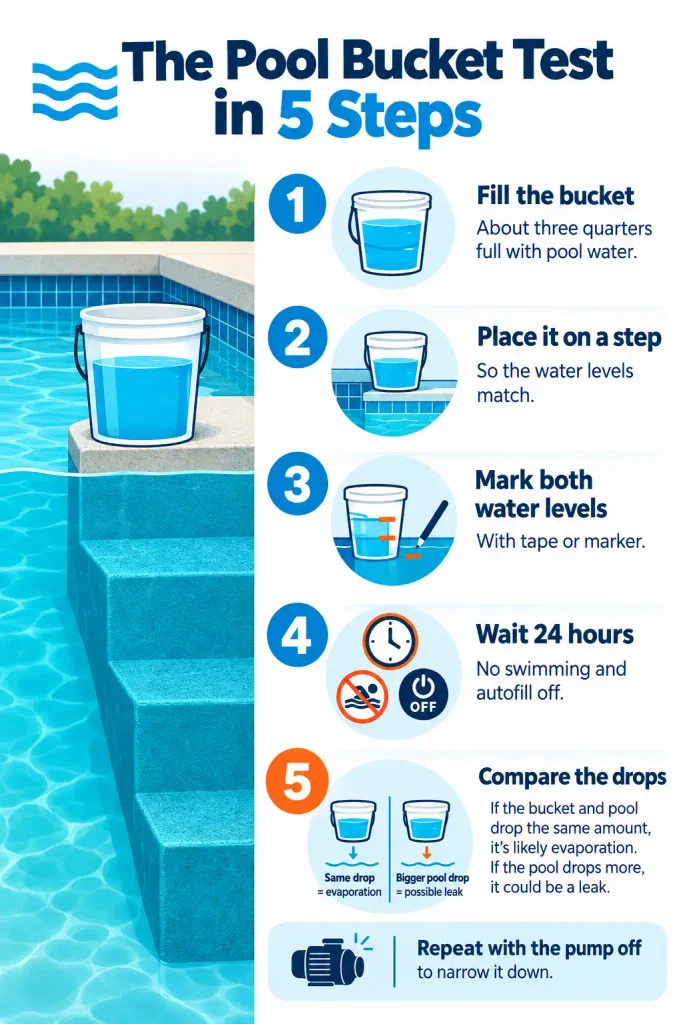
The bucket test is the standard way to separate evaporation from a leak. It works because it exposes a container of water and your pool to exactly the same sun, wind, and temperature. Anything the pool loses beyond what the bucket loses did not evaporate.
Here is how to do it well:
- Fill a clean plastic bucket about three quarters full with pool water.
- Set it on a pool step so the water level inside the bucket matches the pool level outside it as closely as you can.
- Mark the water level inside the bucket on the inside, and mark the pool level on the outside of the bucket or on the tile with tape or a waterproof marker.
- Leave everything alone for 24 hours. Do not swim, do not top off the pool, and do not run the autofill. Turn off any automatic fill system so it does not change the result.
- Compare the two drops. If the pool dropped about the same amount as the bucket, you are looking at evaporation. If the pool dropped noticeably more, water is leaving through something other than the surface.
Give it more than one run if you can. A single hot, windy day can double normal loss, and a single cool, humid day can hide a small problem. A few days of testing across different weather gives you a clearer pattern.
The Pump On, Pump Off Comparison
If the bucket test shows a leak, you can narrow it down further without any tools. Run the bucket test once with the pump running, then repeat it with the pump turned off for another 24 hours.
If the pool loses much more water when the pump is running, the leak is likely in the pressure side of the plumbing or equipment, because the pump is pushing water out through a weak spot. If the loss is about the same with the pump on or off, the shell, a skimmer area, or a fitting at the pool wall is more likely. If the pool stops losing water at a certain level, such as below the skimmer or below a light, that is a useful clue about where the problem sits.
This is not a replacement for locating the exact spot. But it gives you real information to share with a pool professional and it prevents you from paying for guesswork.
Other Clues Around Your Yard
A leak does not always announce itself only through the waterline. Walk around the pool and equipment area and look for hints:
- Wet or soggy ground near the equipment pad, pool deck, or along plumbing runs.
- New cracks in the deck or coping that were not there before.
- Tiles that have separated or a gap between the deck and the pool shell.
- A pool that keeps needing water more than once a week.
- Algae that keeps coming back in one specific area even though your chemistry is fine.
- Air bubbles in the pump basket or return jets, which can point to a suction side problem.
- Water bills that climb with no change in household use.
Any one of these on its own may have a simple explanation. Several together, along with a failed bucket test, make a strong case.
What Can Fool You in Houston
Houston weather can make pool water loss confusing, and knowing the traps saves you from the wrong conclusion.
Heavy rain can raise your water level and hide a leak for days. After a storm, the pool may look full even though it is still losing water. Wait until the level settles and test again.
A pool autofill can quietly mask the problem. If the water level stays steady but the fill valve keeps clicking on, you are replacing lost water without ever seeing it drop. Check whether your autofill runs more than it should, and turn it off during testing.
Backwashing, vacuuming to waste, and splash out from parties can all explain a one time drop. So can a very windy day. This is why a pattern across several days is more reliable than a single measurement.
Finally, Houston’s clay soil moves as it swells in wet weather and shrinks in dry spells. That movement can stress pool shells, skimmers, and buried pipes over time, which is one reason leaks tend to show up after big swings in weather.
Why It Is Worth Acting Quickly
A pool losing water slowly is easy to ignore because the cost seems tiny at first. A few dozen extra gallons a day does not feel like much. But a steady leak means paying for water, chemicals, and heating again and again, and the water escaping has to go somewhere.
Over time, that water can soften the soil around the pool, wash out support under the deck, and contribute to settling or cracking. If the pool sits close to the house, saturated ground can also add stress near concrete slabs and the home’s foundation. Fixing a leak while it is small is almost always cheaper than repairing the damage a long running leak leaves behind.
What to Do Once You Know
Your next step depends on what the tests show.
If the pool and the bucket dropped about the same, relax. Your pool losing water is mostly evaporation. You can cut it down with a cover, by reducing water feature run time, by lowering water temperature a few degrees, or by adding a windbreak.
If the pool dropped more than the bucket, keep the pool filled to a consistent level, avoid draining it, and record your results with dates. Draining a pool unnecessarily can be risky for the shell, especially in areas with a high water table, and it makes the leak harder to find. Leave it as is until you know where the problem is.
Then get a professional involved. A trained specialist can locate the leak using non invasive tools, often without draining the pool. You get a clear answer on whether the problem is in the shell, the plumbing, a fitting, or the equipment, and you can then ask a licensed pool or plumbing contractor for a quote based on a real location. Our team serves Houston, Katy, Sugar Land, and The Woodlands, and you can contact us for a free quote.
If you also notice low water pressure, wet spots indoors, or a rising bill that the pool does not explain, the problem may be plumbing outside the pool. In that case, our water leak detection service can help sort out where the water is really going.
How to Keep Your Pool From Losing More Water Than It Should
You cannot stop the sun, but you can keep a pool losing water from becoming a bigger problem by making it tougher on evaporation and easier to monitor.
- Use a pool cover when the pool is not in use, especially during summer.
- Run waterfalls and fountains only when you are enjoying them.
- Measure your waterline weekly with a simple tape or marked tile, so you know your normal.
- Check your autofill valve and make sure it is not running constantly.
- Keep up with annual plumbing and equipment inspections.
- Watch the ground around the equipment pad after heavy rain.
A short habit of checking the waterline weekly takes less than a minute, and it turns a surprise into an early warning.
Frequently Asked Questions About a Pool Losing Water
How much water should a pool lose in a day?
Most pools lose roughly an eighth to a quarter inch per day, and up to about half an inch in hot, dry, or windy weather. Much more than that, day after day, suggests a leak.
Is my pool losing water from a leak or evaporation?
Run the bucket test. If the pool drops more than the bucket over 24 hours, something besides evaporation is taking water out.
Can a pool lose water in cool weather?
Yes, but evaporation slows down when it is cool and humid. A pool losing water quickly in mild weather is more likely to have a leak.
Should I drain my pool to find a leak?
No. Draining can damage the shell and often is not necessary. Keep the pool at a normal level until the leak is located.
How soon should I get help?
If your bucket test shows a leak or your pool is losing more than an inch a day, call a specialist soon. Leaks rarely fix themselves.
Take the Next Step
A pool losing water is not always a crisis, but it is always worth understanding. Run the bucket test, watch the pattern, and keep notes. If the numbers say the water is going somewhere it should not, call us today for a free quote and same day service across the Houston area.